
SHAPE
South Stratford Housing & Planning for Everyone
Evidence
Consultation Process & Public Participation
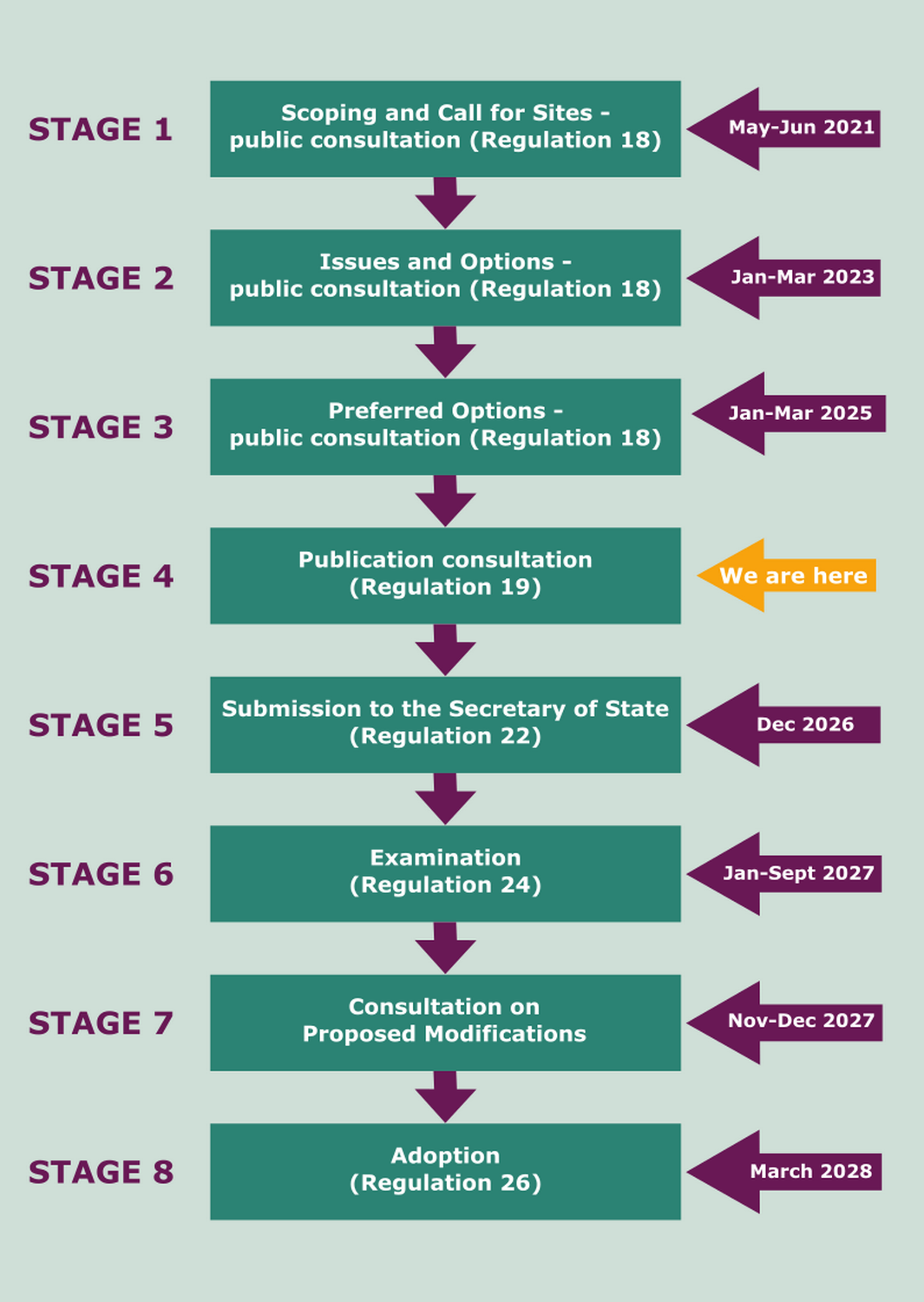
The South Warwickshire Local Plan has been subject to formal public consultation at Regulation 18 and Regulation 19. Regulation 18 was the earlier stage, between January and March 2025, when the emerging spatial strategy, potential development locations and reasonable alternatives were consulted upon and could still be shaped by public feedback. Regulation 19 is the later, pre-submission stage, when the Council consults on the proposed final Plan before it is submitted for independent examination.
This page summarises SHAPE's review of whether, at both stages, affected communities had a realistic and effective opportunity to understand the proposals, scrutinise the evidence and participate meaningfully in the plan-making process.
At a glance
National planning policy requires Local Plans to be shaped by early, proportionate and effective engagement. The issue considered by this review is therefore not simply whether the Councils carried out the formal steps required for consultation, but whether residents were given a realistic opportunity to understand the proposals and participate meaningfully.
Three potential areas for examination have been identified: whether communities affected by different strategic growth locations had comparable opportunities to engage; whether the publicity used by Stratford-on-Avon District Council was sufficiently targeted and effective; and whether the timing and volume of evidence published immediately before Regulation 19 allowed sufficient time for meaningful scrutiny.
1. Were communities given comparable opportunities to engage?
Regulation 18 was the stage at which residents could comment on the emerging spatial strategy, potential development locations and reasonable alternatives before the final strategy was settled.
The available evidence suggests substantial differences in the degree to which local councils actively informed and mobilised residents in communities affected by major proposed growth locations.
In Bearley and Wilmcote, the Parish Council actively alerted residents to the potential new settlement, explained its significance, directed residents to the consultation material, organised a dedicated public meeting and encouraged residents to respond. In addition, the council submitted a formal objection to the plan.
In South Stratford, no equivalent programme of resident-facing engagement by Stratford-upon-Avon Town Council has been identified from its website and social media. In addition, Stratford-upon-Avon Town Council submitted a Regulation 18 response supporting both STR.2 and the Long Marston Airfield development proposal.
This resulted in dramatically different numbers of responses submitted regarding the two locations: the BW proposal generated 1,064 Regulation 18 representations, including 934 objections. By comparison, SG19 / East of Stratford generated 279 representations.
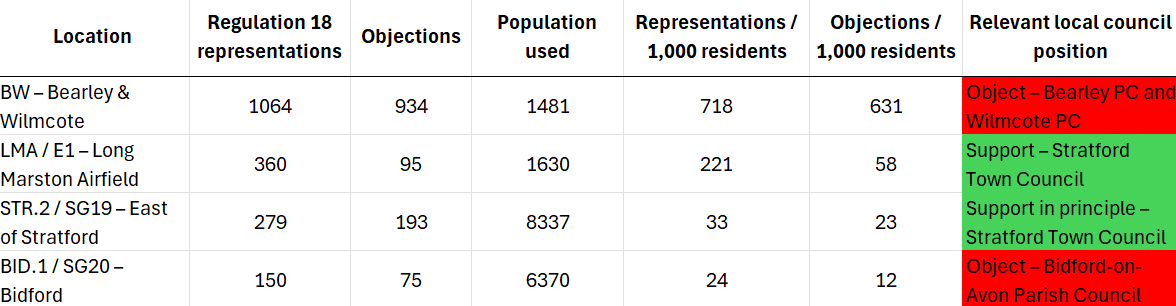
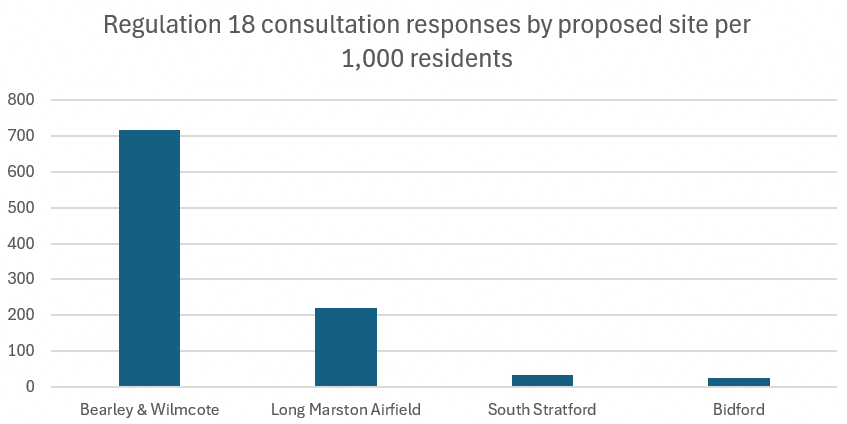
On a population-adjusted basis, Bearley and Wilmcote generated approximately 22 times as many representations per 1,000 residents as South Stratford. These figures do not establish the number of individual residents involved, but they demonstrate a substantial difference in recorded participation.
Key finding
The evidence indicates that affected communities did not necessarily experience the same degree of local awareness or mobilisation during Regulation 18. Wilmcote Parish Council undertook active resident-facing engagement, whereas no equivalent programme of public-facing communication by Stratford-upon-Avon Town Council has so far been identified in relation to SG19.
This distinction is particularly significant because the communities with the highest levels of recorded participation subsequently saw their proposed growth locations removed from the Regulation 19 spatial strategy, while other locations with substantially lower levels of recorded participation progressed.
The issue is therefore not whether a particular number of objections should determine the outcome of a Local Plan. Rather, it is whether residents affected by different strategic growth proposals had a genuinely comparable opportunity to become aware of, understand and respond to the emerging spatial strategy.
Potential policy / procedural concerns
NPPF paragraphs 15–16(c) – Effective engagement
Plans should be shaped by early, proportionate and effective engagement. The approach to consultation should be appropriate to the stage of consultation and the localities it covers.
Statement of Community Involvement
The Councils' stated approach includes public notices, news releases, social-media alerts, notifications to relevant persons, groups and organisations, and notification of Parish and Town Councils. The question is whether these measures operated effectively in practice across communities affected by major growth proposals.
2. Was Stratford-on-Avon District Council's publicity sufficiently effective?
Stratford-on-Avon District Council was under a statutory duty to publicise the Regulation 18 consultation and undertook wider publicity through social media, a dedicated website, promotional videos, press releases, newspaper advertising and public consultation events.
The issue identified by this review is therefore not whether publicity took place, but whether the methods used were sufficiently targeted, accessible and informative to reach residents affected by major strategic growth proposals.
The Council's own figures suggest relatively limited active engagement with its social-media publicity. Across Stratford District's channels, the consultation videos received 1,900 views for the Preferred Options explainer, 1,005 for the Growth Strategy video and 879 for the video explaining the interactive map and response process.
On Facebook, the Council records 33 reactions, 2 comments and 71 shares across 40,989 views. On X, there were 13 likes and 16 retweets across 4,380 impressions. LinkedIn recorded 6 reactions and 1 share across 976 impressions, while Instagram recorded 21 reactions, 3 comments and 17 shares across 1,218 views.
These figures do not establish the number of unique residents reached. However, they raise a legitimate question about whether social media was an effective means of communicating the significance of the proposals to affected communities, particularly where individual allocations involved thousands of homes.
Key finding
The Council undertook a range of publicity activities, but the evidence does not establish that these methods effectively reached residents most directly affected by individual strategic growth proposals or communicated the scale and local significance of those proposals.
The content of the publicity is also relevant. For example, a Stratford-on-Avon District Council Facebook post dated 22 February 2025 presented the consultation through the question “Is it true that 11,000 houses are planned for Stratford-upon-Avon town?”
The response stated that “nothing is confirmed at this point”, explaining that the locations shown on the Growth Strategy map were potential development sites which would be assessed for suitability and that not all would be required for housing.
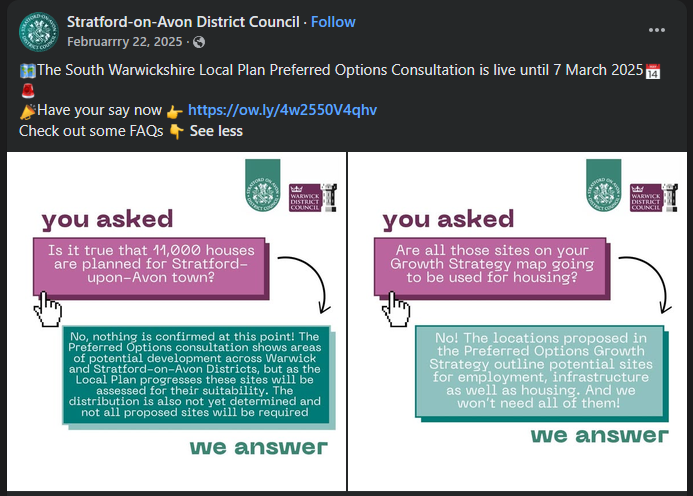
While factually accurate, this presentation provided limited information about what was actually being proposed in particular communities, the scale of individual strategic growth locations or the potential consequences for residents living in or around them.
When residents understand what is at stake, do they engage?
There is evidence from the subsequent experience of SHAPE that relatively low levels of engagement during Regulation 18 should not necessarily be interpreted as evidence of low public interest.
The SHAPE Facebook group was created on 8 August 2026 and, by 20 August 2026, had attracted more than 160 members.
This demonstrates that, when residents understand the potential significance of development proposals to their community, there can be a rapid and substantial appetite for information and engagement.
The contrast raises an important question: did the relatively limited engagement recorded during Regulation 18 reflect a lack of public interest, or was it in part a consequence of residents not being sufficiently aware of the scale and local implications of the proposals?
The Council's more traditional publicity methods also raise questions about how it sought to reach residents who were not already engaged with the planning process.
Printed posters were sent to libraries, while electronic copies were sent to Town and Parish Councils with encouragement to print and display them locally or include them in parish publications or social media. Paper consultation documents and postcard-size information leaflets were also made available at designated deposit points, including all 15 South Warwickshire libraries.
However, the Consultation Statement does not identify an equivalent programme of targeted household leaflet or postcard distribution to residents living in or around the proposed strategic growth locations.
This distinction is important. Making consultation material available at libraries, Council offices and online, or placing responsibility on Town and Parish Councils to reproduce and distribute posters, is not necessarily equivalent to actively notifying the communities most directly affected by individual proposals.
Key question
Did the publicity merely make the existence of the consultation known, or did it provide affected communities with a realistic opportunity to understand the scale and local implications of the choices being consulted upon and participate effectively?
Potential policy / procedural concerns
NPPF paragraphs 15–16(c) – Effective engagement
The engagement approach should be appropriate to the stage of consultation and the localities covered, using proportionate methods capable of reaching affected communities.
Statement of Community Involvement
The Council's stated consultation methods include public notices, news releases, social-media alerts and notifications to relevant persons and local councils. The question is whether those methods were sufficient in practice to provide effective engagement with residents most directly affected by major growth proposals.
3. Was there a realistic opportunity to scrutinise the Regulation 19 evidence?
Regulation 19 is the final formal consultation before submission of the Plan for independent examination. The Publication Plan contains the final growth strategy, final locations for growth and final policies, with representations principally directed towards legal compliance and soundness.
Meaningful scrutiny at this stage therefore requires consultees to understand the evidential basis for the final Plan and, where evidence has changed, to understand what changed, why it changed and what effect those changes have had on the Plan.
The Technical Evidence Register shows a substantial volume of evidence completed or updated in the three months immediately preceding Regulation 19. At least 37 evidence entries are recorded as completed in May 2026, with a further 20 entries completed in June or July 2026.
These include evidence concerning proposed growth locations, capacity, sustainability, transport impacts, infrastructure, heritage, viability and deliverability. The material includes reports, appendices, site-specific assessments, addenda and supplementary documents.
Key finding
A substantial body of evidence was completed or materially updated shortly before Regulation 19. Meaningful scrutiny requires more than reading those documents in isolation: consultees may also need to review earlier versions of the evidence base and consultation material to understand how the Plan and its evidential basis have evolved.
In several cases, the newer evidence builds upon or supersedes earlier material. This includes revisions to the Growth Strategy evidence, the Green Belt Review and the HELAA, together with numerous addenda and supplementary documents.
Meaningful scrutiny may therefore require comparison with earlier consultation and evidence documents dating from November 2024 onwards, rather than consideration of the Regulation 19 evidence in isolation.
The practical time available for scrutiny
The Regulation 19 consultation opened on 21 July 2026 and closes on 8 September 2026, giving consultees seven weeks to undertake this exercise.
The consultation also encompasses the whole of August, including the school summer holiday and the main period for annual leave. This is particularly relevant where residents and community groups are expected to undertake detailed review of a large and technically complex evidence base on a voluntary basis.
The issue is therefore not simply whether seven weeks constitutes a formally adequate consultation period. The question is whether, given the volume of evidence completed or materially updated immediately before Regulation 19, the need to consider that evidence alongside earlier iterations and consultation documents, and the timing of the consultation across the summer holiday period, consultees had a realistic opportunity to understand the evidential changes and formulate fully informed representations.
Potential policy / procedural concerns
NPPF paragraphs 15–16(c) – Effective engagement
Effective engagement requires an approach proportionate to the stage of plan preparation. The practical opportunity available to consultees to understand and respond to the evidential basis of the Plan is relevant to whether engagement was effective in practice.
Evidence supporting the Publication Plan
Where evidence has been substantially revised or completed shortly before Regulation 19, the supporting material should enable consultees to understand the basis for the final strategy and assess its implications for soundness and legal compliance.
Overall issue
Taken together, these matters raise a broader question about whether the consultation process was effective in practice, rather than simply whether the Councils undertook the required formal consultation activities.
The central issue is whether affected communities had a realistic opportunity to understand the proposals, scrutinise the evidence and participate in an informed way, consistent with the NPPF requirement for early, proportionate and effective engagement.
Would you like to add this evidence to your Regulation 19 submission?
We've prepared a PDF version of this page that you can download and include with your Regulation 19 submission.
Download this page as a PDFRead the full technical review
This page summarises the principal findings from SHAPE's review of the South Warwickshire Local Plan consultation process. The full report contains detailed evidence concerning Regulation 18 engagement, community mobilisation, Council publicity, consultation methods, the Regulation 19 evidence base and the practical opportunity available for public scrutiny.
Download the full report (PDF)